The first question in any recycling pelletizing project is how the material will get into the screw. Light, bulky film and dense, free-flowing flakes behave completely differently in a feed throat. That difference decides whether you need an ML or an SJ line.
Film feeds badly, flakes feed easily
Film, raffia and non-woven material have a very low bulk density. Poured into a normal hopper, they bridge and the screw starves. Rigid flakes and regrind are dense and flow on their own, so a standard hopper feed works.
ML series: for clean film scrap and fibrous material
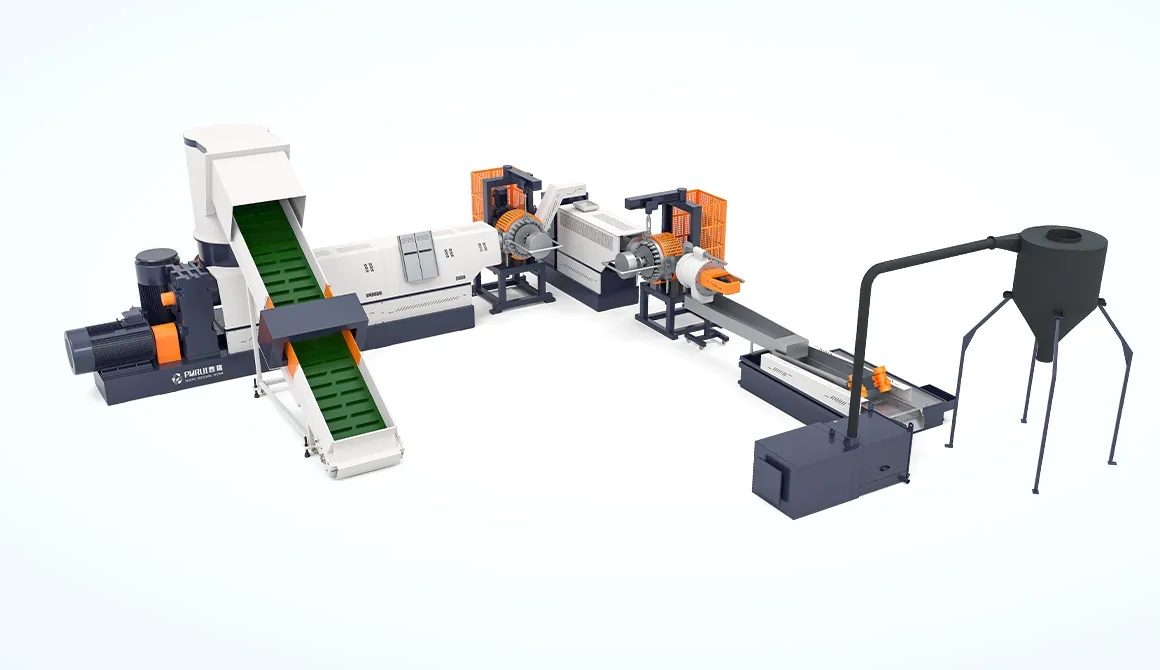
The Jiangsu PURUI ML series is built for clean, dry BOPP, PP, HDPE, LDPE, LLDPE, PS, PLA and PET film scrap, non-woven fabric, woven bags and fibre, fed directly without washing.
| Model | Screw diameter | PP (kg/h) | HDPE (kg/h) | LDPE (kg/h) |
|---|---|---|---|---|
| ML75 | 75 mm | 100 | 120 | 150 |
| ML85 | 85 mm | 120 | 150 | 180 |
| ML100 | 100 mm | 200 | 300 | 400 |
| ML130 | 130 mm | 400 | 500 | 600 |
| ML160 | 160 mm | 600 | 700 | 1,000 |
| ML180 | 180 mm | 800 | 1,000 | 1,200 |
SJ series: for rigid flakes and regrind
The SJ series is a single-screw recycling extruder for HDPE bottle flakes, crushed rigid PE and PP, PP, PC and ABS regrind, and washed film flakes.
| Model | Screw diameter | Output |
|---|---|---|
| SJ100 | 100 mm | 250 – 350 kg/h |
| SJ120 | 120 mm | 300 – 400 kg/h |
| SJ140 | 140 mm | 500 – 600 kg/h |
| SJ150 | 150 mm | 600 – 800 kg/h |
| SJ160 | 160 mm | 800 – 1,000 kg/h |
| SJ180 | 180 mm | 900 – 1,200 kg/h |
| SJ200 | 200 mm | 1,000 – 1,500 kg/h |
All SJ models run at 10 to 150 r/min with an L/D of 18 to 42.
See a real line: food-grade HDPE milk bottle flakes, SJ110 + TSSK75 two-stage line, with photos and video.
Washed film goes to an SJ two-stage line
After a washing line, film flakes are not pelletized on an ML line. They go to an SJ two-stage line: the first extruder melts and degasses, and the second filters again and pelletizes. For large outputs, a laser filter is added. See the agricultural film recycling guide.
When you need two stages
Heavily printed film, film with residual moisture and material with volatile contamination often need a two-stage line: a first extruder melts and degasses, and a second extruder filters again and pelletizes. Ask for a two-stage configuration if your pellets show bubbles, odor or black specks on a single-stage line.
A quick way to decide
- Clean, unwashed film scrap, raffia, non-woven: ML series
- Washed film flakes from a washing line: SJ two-stage line, with a laser filter for large outputs
- HDPE bottle flakes, crushed rigid PE and PP, PC or ABS regrind: SJ series
- Heavily printed or moist film: ask for a two-stage configuration
- Mixed film and rigid material: send photos of both; the share of each decides the line
Output always depends on the material, its moisture and the motor configuration. A material trial at the factory is the surest way to confirm it. Full tables are on the recycling machines page.
See also: How to choose a screen changer for recycled PE and PP.
Tell us your material and target output
Send the material type, output in kg/h and final product. We reply within 24 hours with a configuration and price range.
- WhatsApp: +86 130 1820 8126
- Email: meng@torqplas.com
- Email: purui09@purui-china.com